Consumer expectations, shopping habits and media consumption continue to evolve, and dairy checkoff is evolving with them. In this episode of the Your Dairy Checkoff Podcast, host Scott Wallin sits down with Aris Georgiadis of Dairy Management Inc. to discuss how dairy checkoff is reaching consumers with science-backed information and engaging marketing strategies that help build trust and support dairy sales.
The conversation explores several consumer-facing initiatives, including the First 1,000 Days program, which helps educate parents on dairy's role in early childhood nutrition and cognitive development, and We Are Family, a retail activation program designed to reach families at key points along their purchasing journey.
Listeners will also hear how Dairy Does More is helping consumers discover the many benefits of dairy beyond what they already know, using humor, digital content, influencers and retail media to connect with audiences across multiple channels. The discussion highlights how dairy checkoff leverages nutrition science, consumer research and strategic partnerships to ensure consumers receive credible information that strengthens dairy's reputation and creates more opportunities for dairy consumption.
Host & Guest
- Scott Wallin, Vice President of Farmer Communications & Media Relations, Dairy Management Inc.
- Aris Georgiadis, Senior Vice President of Marketing Communications, Dairy Management Inc.
Transcript (AI-Generated, please ignore typos)
Your Dairy Checkoff Podcast 00:02
Welcome to your Dairy Checkoff podcast from Dairy Management Inc. where dairy checkoff leaders and farmers share real stories, strategies, and insights that grow sales and build trust for U.S. Dairy. Let's get started.
Scott Wallin 00:19
Hi, everybody, and welcome to another edition of the Your Dairy Checkoff podcast. I'm Scott Wallen with Dairy Management Incorporated, and today I'm joined by my colleague Aris Georgi Adis, and we're going to talk a little consumer marketing. Aris, how you doing today?
Aris Georgiadis 00:33
I'm doing all right, Scott. Thanks for having me on the podcast.
Scott Wallin 00:36
Well, you know, I always find talking. You've got so many exciting things that we want to get into and share with our farmers and dairy importers who fund the check off. Before we get into some of the strategies, I know there's some exciting things in market right now. You are part of the marketing and communications and affairs team for dairy management at MCA. Why don't we start there? Talk a little bit about what your role is with with this MCA team and overall what that team is responsible for.
Aris Georgiadis 00:58
Sure. Well, to put it broadly, the marketing, communications, and affairs team is really about reputation, and what we're looking to do is ensure that the reputation of dairy is supported across the unified plan, right? So across our outcomes. Specifically, what we're looking to do is we want to ensure that consumers think of dairy as a health and wellness solution, right? That's primarily one of the key outcomes. The other core outcome for the MCA is to make sure that key opinion leaders and the industry are visibly and vocally supportive of dairy as part of a sustainable food system, both nationally and around the world, where we fit my team, the digital digital marketing and communications team within MCA, our role is primarily that consumer outreach, right? So how do we take and make sure that we are both protecting and defending Gary's reputation when we're in market?
Scott Wallin 01:59
Yeah, so I did mention thereafter two strategies in market right now. I want to start talking about first 1000 days, and this is something I know that it's based in a lot of great research and science. We started talking a lot about this as a check off a few years ago, and I know it focuses a lot on brain health and cognition. But take it from there. Talk about from the science. What do we got going on with this strategy.
Aris Georgiadis 02:21
I, you know, it's a wonderful program. It's a program that I support and I've loved and I've loved working on it all these years. And I'll tell you, what makes it unique in the marketplace is that it's a new audience, right? So when we think about, you know, parents or young parents, new parents or expecting parents, they are inundated with information, right? And this is a crazy time. I mean, I'm a dad. My wife and I, I still remember what it felt like when we were expecting our first child, and you you don't know anything, right? You think you do, and you're getting bombarded with information. You're getting bombarded with all this advice, and there's a lot that you just simply don't know, especially when it comes to nutrition, both for the the mom to be and then for your baby, right? So the overall strategy for us is to really make sure that we are communicating that nutrition science in a way that is not frightening, not scary, that we are there to be a helpful solution, right? To what a a parent and and young parent is looking for when it comes to information about hey, what am I what am I feeding myself and what am I feeding my child? It's an excellent program to really bring forward that nutrition science, but also to your point about cognition, you probably as a like I could say this personally for myself, I did not know I knew that dairy, for example, when my wife and I were first expecting, we knew that dairy was important for bone health, right? That physical development, we did not know the importance of dairy for cognition, right? And cognition, especially within that first 1000 days of life, that first two years, so important, so critical. But you're not going to know it until your time, until it's time for you to have a family, yeah, and that's where the communication becomes critically important in making sure that we're reaching all these young families where they're getting information from, and in a in a manner that hopefully makes them laugh and not stresses them out when they're when they're seeing the work.
Scott Wallin 04:39
It's definitely a stressful time. We think another human being into your into your world, but I want to build off that a little bit. You know, we're we're in the digital age, obviously, and people are they go to their laptops or their phones for information. That's that's that's the stop number one. We are working with two companies, the Baby Center and What to Expect, that are mass. I mean, I think you've said this is where parents are going. Oh, absolutely. Talk a little bit about each of these these parts and just why we identified them.
Aris Georgiadis 05:08
Oh, absolutely. And I think I'll get into that in a second. And I think, like, I want to start with your broader point about the the digital world that we live in, right? So, you know, we've all heard the expression "Doctor Google, right? We're all asking information. Most people are also getting information from TikTok these days, or they're still getting it from search engines, or now they're getting it from AI sources, right? So part of our overall strategy is to develop a breadth of content that can be found no matter how you're searching. So whether you're asking Gemini or you're asking Claude, right? What is? Are we creating enough content on our website usdairy.com that we could ensure that that information is being pulled into those large through the large language models that are answering those questions that a mom might have or even a dad might have about nutrition or development. So first of all, and primarily, that takes a lot of work, right? It takes a lot of partnership with a lot of our colleagues across DMI and across the MCA to make sure we're developing not just long-form articles, but also using influencers, for example, right? Somebody that a mom or mom could be will find relatable, right? So have that influencer, that you know what we used to call a mom blogger, right? But now they're they're on Instagram, they're on TikTok, and they're developing really smart content about hey, this is what I have to do to manage my growing family. This is what I feed them. This is what I think about. Here are sleep habits. Here is you know nutrition information, and then we also have just really fun, quick videos that we could put across a number of digital channels. So if you just happen to be scrolling past and you see something that says, "Hey, you know dairy is good for your bones, but did you also know, right? And that strategy is very important because we we know we understand what consumers believe they know about dairy, but we have an opportunity to give them a little bit more information when it comes to these surprising benefits. And then from there, to your point, what are those trusted sources where consumers turn to for information? Right. So beyond the the Googles and beyond the TikToks, I know from experience as a sample of one where my wife and I got information from. But I also know from just the the world at large, two of the biggest sources of information remain baby center and what to expect when you're expecting. It's critically important for us to make sure that we have our dairy positive and dairy forward content on those sites. So again, as you're going there seeking information, it could be sleep information, it could be other types of information. But while you're there and you're perusing the site, maybe you're asking or want to know more about what to feed an infant or what to feed your child when they turn six months old, right? When you can start introducing solid foods, right? Make sure that our information is present so they can see the progression. Oh, here's what I do at six months. Here's what I could do at nine months. Here's where I could introduce, you know, milk at a year, etc. So that is critically important, but it creates a surround sound. So it it starts with those small videos, the articles on the website, the influencers, making sure that content is is shared widely across our channels, but also the channels of our partners, so that they're also promoting it on their channels as well, and that surround sound, so to speak, is how we want to make sure that no matter what that touch point is for you know mom, mom to be, dad, that they're getting the information that they need, and this is critically important information.
Scott Wallin 08:56
And it's so cool to go to those sites and see dairy from absolutely. That's that should be so rewarding. You know, at the root of all this is research and science. Absolutely, the National Dairy Council is the leading organization when it comes to dairy research and science. You know, they've built decades long.
Aris Georgiadis 09:13
My best friend's reputation.
Scott Wallin 09:15
Well, that's what I want to. I want to talk to you about that. Yeah, let's do that. So much of these consumer facing strategies that your team does is based in the work NDC has led. You know, there's that wonderful intersection. You guys get to science and research, and you figure out how do we take that now to the consumer. Can you talk a little bit about that process and how critical that
Aris Georgiadis 09:33
is? Oh, I I I almost don't know where to begin. I mean, to your point, how do you take a a giant science research report about the benefits of iodine and choline, which are so critical, right, to the cognition you were talking about, right to that, to the mental development of a of a infant, and turn it into a TikTok, right. So we rely so much on and. DC on the National Dairy Council for helping us craft those messages, make sure that we understand the science, so that we could translate it properly and effectively, and if necessary, with humor, right to to make sure that hey, mom, we got your back. We're right there. Dairy's got you. We're supporting you. You don't have to stress too much. There is a lot going on in your life, but beyond that, it's not just the work that they do for us in partnership with us. I think about what what the National Dairy Council does, for example, in terms of outreach with the broader health and wellness community. Right, the work we do is so important, but it's also amazing that NDC can have those connections with the American Academy of Pediatricians, for example, right? Or they could talk to leading health and wellness professionals, because it's not just enough when we think about yes, we have influencers who can help spread our message. We have great articles that could help communicate this science, but hearing it from your pediatrician, right? Hearing it from a nurse practitioner, hearing it from a leading health organization that supports dairy, right? It's part of those outcomes we were talking about earlier. Vastly important, and I cannot emphasize enough that critical role that National Dairy Council plays in spreading that news-not just here nationally, but the work they do globally as well. Right, so very important. But that science, you know, goes back to what we were saying at the beginning about reputation. Right, you can, you can lose reputation very quickly if we are not credible when we're communicating this information. If the those large language models are pulling content off of our website and using it in the overviews or in the answers to those consumer questions, if we're not credible, our reputation gets dinged, and if our reputation gets dinged, sales will get dinged. Right. So knowing that we have the authoritative voice of National Dairy Council and the authoritative voices of all these other health and wellness organizations is critically important to our mission.
Scott Wallin 12:17
Absolutely, that gets at the the very being, the very purpose of the dairy checkoff: grow sales, build trust. Absolutely, without that credibility, we're not doing that. So that that's an awesome summary of strategy number one. We're going to go ahead and get into strategy strategy number two, which is called We Are Family. Oh, we are family. Yeah, a retail program. Why don't we start with just an overview of We Are Family?
Aris Georgiadis 12:37
We are Family is, to your point, it's a retail activation that is now in it in its third year, where we are looking to use retail media to reach families, right? Specifically, parents with kids in the home, and what we're trying to do through that media strategy is understand all the different opportunities and occasions that we can leverage, what levers we can pull, to make sure that we're getting messaging in front of consumers at different times of day to consumers who perhaps are that we could segment based on different lifestyles. So this way, it's a it's an opportunity for us to be able to hit those retail chains to to hit those retail networks to ensure that we're getting the right message at the right time to the right consumer, especially as they're at that moment of point of purchase.
Scott Wallin 13:38
You know, we talked about obviously the research aspect from a nutrition standpoint, dairy, but there's also a heck of a lot of research that occurs into understanding the consumer. A lot of intelligence. Yeah, yeah, absolutely. And I know your team relies on understanding where the consumer's mindset is today. Can you just kind of talk a little bit about understanding the consumer and and knowing where the consumer is heading, what the trends are, how does that shape a program like We Are Family?
Aris Georgiadis 14:05
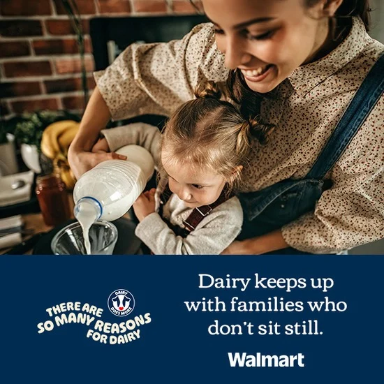
Oh, I mean that's a fantastic question. So both from the insights gathered here at Checkoff through the strategic intelligence team, whether that's consumption data that we receive or it's the Kantar reports that we publish and the other sales and marketing, the other sales data that we've received, our agencies are also fantastic partners, and they provide us really detailed insights on consumer behavior and on especially on consumer mindsets. When you think about our target audience, right? So in the unified plan, we talk about how we want to reach families with children in the house and teens-that's hundreds of millions of people, right? So insights help us narrow that field down, right? So we can understand: okay, who are we really targeting? Where do we want to target them? What are they doing on those channels? What are their behaviors? But then also marry that with what are their purchasing habits? Where do they go to purchase? If they're at a Walmart, for example, what does that shopping opportunity look like for them? And how is that different than when they're at Costco, for instance? Or if they're shopping online only, what are those online shopping behaviors? What kind of ad do they need to see to then be able to hit that button that says "Click to Cart, right? Or convert a recipe into a shopping list. That shopping list then enters their cart, right? So all of those insights help inform, let's call it that consumer journey, that pathway, right? So they'll see an ad. They might see something on one of our channels, like on Disney Plus, where we have some of our campaigns running, they might see something that says there are so many reasons for dairy. Then they might be on their phone right after they've watched something program on their on their connected device. Now they're on their phone. They're scrolling. Oh, now they see an ad. Right, the ad says something also about so many reasons for dairy, but now it might have a very specific message about protein. It's like they know, oh hey, I need to get protein, right? So then, maybe they put their phone down, they pick it up a little bit later. Now it's a video of an influencer or creator. That creator is talking about a fantastic recipe they put together that not only tastes great, but has a little bit of extra protein to it, right? Or it's something that they used as a post-workout meal. Now that same consumer has heard there are so many reasons for dairy, that dairy has protein, that there are delicious recipes, and they've seen this across different channels. And now they're getting that last ad served, that's probably on Walmart.com, that reminds them add dairy to the cart.
Scott Wallin 16:48
Yeah, that's that's a big player right there. Yeah, I love the idea though that this is taking the guesswork out of it. We're really understanding the consumer, and I think that's just so critical. Instead of just wondering where's the consumer at, we have a very good idea of how to reach them, you know. Can I build
Aris Georgiadis 17:03
on that? Because you're right. It does take the guesswork out, but then it makes the strategy that we develop very important, right? So because we have to take those insights and convert it into a strategy, so we're not being ineffective with what channels we're on. So to your point, we're not guessing, but we still need to make sure that we have a deep understanding of that behavior to make sure that those channels are the right channels to be on. It's a big world out there digitally, right? So you have a lot of options, and we don't want to, you know, be inefficient with how we spend dollars across that digital landscape. So the strategies and the tactics are very important when we're developing these programs, and we take learnings year over year, right? So we continue to refine and hone not only the message and the audience, but also what are they doing and what are those occasions. Because ultimately, what we really want to do in a program like this is make sure that consumers are are discovering more opportunities and occasions to do dairy daily.
Scott Wallin 18:11
Yeah, great summaries of the two that are in market now. Again, it's it's first 1000 days we are failing. But earlier this year, we we talked a lot, and we launched Dairy Does More. Ah,
Aris Georgiadis 18:22
yes. So
Scott Wallin 18:23
why don't you just give us a quick summary of that? What I love about that program is it's really trying to show consumers those surprising sides of dairy. That's
Aris Georgiadis 18:30
sort of what we were talking about before, right? It plays very well into if you think about the first 1000 days, you might know that dairy is good for your bones, but it's also good for cognition. We work with a fantastic agency called Mischief, who helped develop this new strategic framework. Right, so it's beyond just the campaign itself. Dairy does more is our strategy for how to reach the consumer. And to your point, the insights that the agency provided on the consumer mindset is that you know dairy is a very complex product, right? There, maybe you love it for taste, or maybe you know it has protein, or maybe you drink it because it also hydrates. There's so much going on with dairy, but sometimes what happens with with dairy foods or all foods in general, is it becomes a habit, right? Whether that is our products or whether it's you know how you enjoy a turkey sandwich or how you enjoy you know an omelet, after a while you only think of it as this one thing, right? And that creates a bit of a tunnel vision when it comes to the consumer, right? So, for example, maybe you only drink milk because you have cereal at home, or maybe you only think about yogurt for breakfast, for instance. How do we get the consumer to recognize, as the name says, that dairy does more, right? Because if we want to get consumer. To do dairy daily, we need to create those opportunities that lead to additional occasions for them to add dairy to their cart, right? So the program which leans into humor, which is very important. I mean, let's face it; it's a you know you're bombarded. What? It's I think I read somewhere it's 10,000 ads a day. How do you stand out, right? Well, if you're not funny, I'm not funny, but the ads are, which is great. So yeah, sell
Scott Wallin 20:31
yourself short. Okay, well, made me laugh.
Aris Georgiadis 20:33
Okay, just a couple of yeah. Sorry about that. But no, it's so it's critically important that we leverage that humor when we're creating the campaign under the Dairy Does More umbrella to make sure that message is sticking right. So to your point, what Dairy Does More ultimately is is we are the friendly revealer of those hidden benefits. Right, so those reasons to believe, as we say, that a consumer might not know. So if they know us for taste, here's some nutrition that you may not be aware of. If you come to us because you've heard so much about protein, hey, here's a great recipe that tastes delicious. Oh, and by the way, it's also good for your bones. Case you forgot, right? So because you again, that tunnel vision kicks in. If it's only protein, you may have forgotten. Good for your bones too. Don't forget, you know our original vitamin D infused product here. Yeah, so no, it's it's very important. It's it's been great. And so with the new framework of Dairy Does More, we did launch a new campaign. So new ads in market. They started in February. They're still in market now. We just introduced a new one in September, in time for back to school. The campaign itself is called "So Many Reasons for Daring. So, as the name implies, each ad, whether it's our 30-second videos, our 6-second videos, the work we're doing with influencers, and or our social content, is really again to remind people that it's not just that one thing you know that there are so many reasons to enjoy dairy, which ultimately means there are so many reasons to add dairy to your cart. Yeah. So trust in sales all the time. It all
Scott Wallin 22:14
comes together, doesn't it, in one big bundle? Last question. I know there's probably farmers and the importers who farmed us. They're going to look for some of this content. I know that we're on the on our social media channels. There's YouTube. This talk, yeah, absolutely. So,
Aris Georgiadis 22:28
so undeniably, Dairy is still our consumer-facing brand. So our channels are part of Undeniably Dairy. So you could find us on Instagram. You could find us on YouTube, for example, Facebook, TikTok. So you could see the work there. You could also get some really great recipes, by the way, on those channels, right? So we're also on Pinterest, but also we do have a YouTube. So if you go onto YouTube, look for Undeniably Dairy, you will find our page where you could see those spots, as well as usdairy.com. It's our core website. The videos are on the website as well as a breadth of content, whether that's video content, whether that's nutrition science, whether that's recipes. All of that can be found on usdairy.com.
Aris Georgiadis 23:15
Yeah, there's so many resources. Resources are there as well. So if they really want to go deep on the science, or be able to turn the science on to colleagues, or friends, or neighbors? It's a great place to get all the information that they need. And I'm going to put a plug in for our website, Dairycheckoff.com, for farmers and importers who want to learn more about what we're doing to build build sales and grow trust.
Scott Wallin 23:40
Aris, thank you so much for the conversation,
Aris Georgiadis 23:41
Scott. I appreciate it. I enjoyed your insights. Thank
Aris Georgiadis 23:44
you.
Your Dairy Checkoff Podcast 23:47
Thanks for listening to your Dairy Checkoff podcast. Want to hear more about how your checkoff is making every drop count? Head over to dairycheckoff.com or follow us wherever you get your podcasts. See you next time.
 Listen
 Read
Read
Read
Read
Read
Read
Stay Informed
Subscribe to our newsletter, delivered twice a month to your inbox. You will receive updates on the latest checkoff initiatives and projects, valuable insights, and more information on how we're growing sales and building trust in U.S. dairy.
Please enter a valid email